

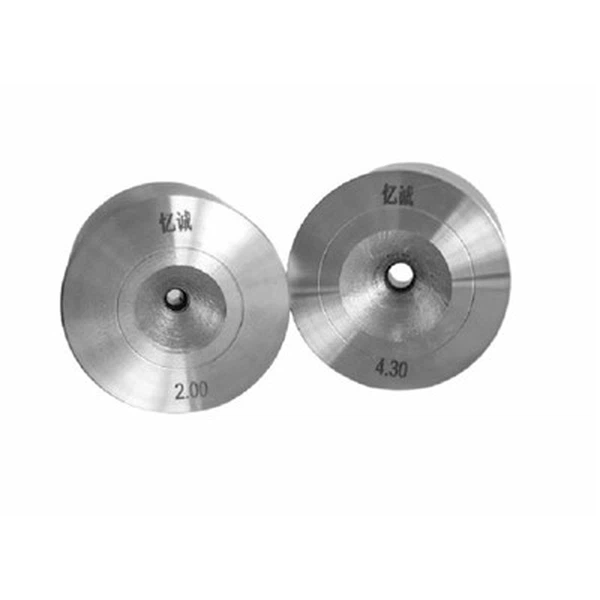
PCD Wire Drawing Die
PCD wire drawing die are ideal for long production runs and for drawing abrasive wire materials as they outlast tc, sscd and nd dies. Polycrystalline diamond dies are available in various grain sizes, both in supported and unsupported configurations. Pcd wire drawing die provide uniform hardness and extended wear resistance in all directions.Wire drawing dies are commonly used to reduce the diameter of various ferrous and non-ferrous rods and wires. Applications include high, medium and low voltage cables, automotive, medical wire, superconducting, bonding, and welding wires.
Advantages of PCD Wire Drawing Die
High drawing efficiency
Pcd dies can reduce friction and provide an excellent surface finish, which contributes the smoother wire through the dies, the process of drawing is much faster and more efficient. Pcd dies improve the efficiency of drawing, and then increase productivity.
Consistency in wire diameter
Pcd dies can keep the stability of wire sizes during drawing, which means the wire diameters can remain more consistent, and then pcd dies can produce higher quality and more exact wire products. It reduces the changes in wire diameter, improves the technological control, and reduces the extra adjustment or reworks.
Versatility in wire materials
Pcd dies can be used with a wide range of wire materials, including copper, aluminium, and various alloys. This versatility allows for greater flexibility in wire drawing operations and expands the potential applications for pcd dies.By leveraging the advantages of pcd dies, you can enhance drawing efficiency, extend die lifespan, save raw materials, and reduce labor intensity.
Reduced labor intensity
Because pcd dies has a prolonged lifespan and slow expansion, they need not be replaced frequently. Compared to the use of carbide drawing dies, pcd dies do not require constant monitoring of changes in wire dimensions, which reduces the labor intensity of workers. To use pcd dies, a single worker can manage 4 to 5 wire drawing machines during the production process.


Why Choose Us
Our factory
Founded in 1980,cangzhou yicheng wire die co., ltd. Is a comprehensive die professional enterprise integrating r&d, production, sales and maintenance.Through the unremitting efforts of yicheng people, the production scale and service scope of the enterprise are expanding day by day.
Our product
At present, the main products are: Electromagnetic wire drawing die, power transformer wire drawing die, light voltage wire drawing die, wire and cable wire drawing die, diamond coated wire drawing die, stainless steel wire drawing die, etc.
Production market
The company's products are sold to more than 100 domestic enterprises in more than 20 provinces, accounting for 70% of the domestic market share.
R&d team
Cangzhou yicheng wire die co., ltd. Is a comprehensive die professional enterprise integrating r&d, production, sales and maintenance.
Entrance area
The entrance angle of the inner hole is a crucial parameter in pcd drawing dies. The inlet area of the pcd drawing dies shapes a smooth profile for lubrication and deformation zones, facilitating the lubricant’s access to the drawing dies’ working surface. Therefore, maintaining the wire’s contact point at the same level in the depressed area of the pcd drawing dies is essential.
Lubrication area
The lubrication area serves to store and inject lubricant into the work area. The taper angle of the lubrication area varies based on lubricant viscosity, wire diameter, and lubrication area length. To ensure the smooth entry of liquid lubricant into the working area, a larger lubrication area cone angle is typically selected.
Working area
The working area undergoes plastic deformation of the wire. Achieving concentricity between the wire axis and the inner hole of the pcd drawing dies during the drawing process is challenging. Excessive wear on the inner hole from previous drawings can lead to increased wire diameter, causing deformation outside the designated area. Hence, the working area’s length should exceed that of the actual deformation area.
Sizing area
The sizing area’s diameter is determined by the allowable tolerance of the wire rod and its elastic deformation during drawing. Insufficient sizing area length can result in wire shaking and the formation of coarse knots during drawing, leading to rapid wear of the pcd drawing dies’ inner hole and size deviations.
Exit area
The exit area typically forms a right angle in pcd drawing dies. This angle allows the pcd drawing dies to return to their original size multiple times without requiring retooling.
PCD is commonly known as the “artificial diamond, PCD is a top-quality material for wire drawing dies. Its working life is 15-25 times than the working life of tungsten carbide dies so that improving efficiency and saving cost for users. There are two main processing methods of PCD wire drawing dies.
The first method. The advantage of this method is that the transparency of the diamond can be used to observe the machining process such as opening L. Its disadvantage is that it needs to grind off part of the diamond; The diamond is very small, so it is not convenient to fix it during processing. This method is used when machining small diameter die holes.
The second method. First, the diamond and the related powder are sintered into blocks and inlaid, and then each process is processed. The disadvantage of this method is that it can’t directly observe the machining process of the die hole, and its advantage is that 2 / 3 ~ 4 / 5 of the diamond can be ground out less than the former method, the center can be easily determined, and the operation mode is convenient, so it is often used to process large diameter diamond die holes. When the diamond dies is used in drawing, there are some defects on the surface of the die hole, such as stripe, sticking metal, elliptical wear of the die hole, and increase of the diameter of the sizing belt, it needs to be reground and reused after increasing the diameter of the die hole. Regrinding can be repeated until the diamond cracks.
Classification Of Polycrystalline Materials of PCD Wire Drawing Dies
Common Polycrystalline Wire Drawing Dies
Our term is tsp. It is sintered with “silicon” as the binder. It is characterized by its low price,high-temperature resistance below 1600 degrees and good wear resistance (about 10 times the life of carbide dies), but its surface finish is not very good.
Classification of polycrystalline materials of polycrystalline drawing dies polycrystals in pdc drawing dies are mainly divided into the following 3 categories:
High-density polycrystalline wire drawing dies: Our term is tsp. It is also sintered with “silicon” as the binder. As the name suggests, its density is relatively high, characterized by the low price,high-temperature resistance below 1600 degrees, and good wear resistance (about 15 times the hard alloy die). Still, its surface finish is not very good.
High crystal poly wire drawing dies: The term is “pcd”; it is sintered with “cobalt” as the binder. It is characterized by high price,high-temperature resistance below 1200 degrees, and very good wear resistance (15 times life than carbide dies), but its surface finish is good.
Cd polycrystal wire drawing dies: The term is “pcd”; it is sintered with “cobalt” as the binder. It is characterized by a relatively high price,high-temperature resistance below 1200 degrees, very good wear resistance ( 30 times use life than carbide dies), and its surface finish is greatly good.
How to Prolong the Service Life Of PCD Wire Drawing Dies?

The Methods For Improving The Service Life Of Drawing Dies
In order to prolong the service life of the drawing die, it is necessary to select the suitable die material, design the reasonable pass size, improve the manufacturing level of the drawing die, and make the surface finish of the die meet the technological requirements, it is also necessary to determine the reasonable drawing surface shrinkage and improve the service conditions of the drawing die. Pay attention to the daily maintenance of the mold in the use process, wash and replace frequently, and ensure a good lubrication effect in the drawing process.
Similarly, for the drawing machine, we should pay attention to the following matters
The installation foundation of the wire drawing machine should be very stable to avoid vibration;
During installation, the drawing axis of the wire rod should be symmetrical with the center line of the die hole through debugging, so that the stress of the wire rod and the drawing die can be even;
Avoid frequent starting and stopping during the drawing process, because the friction caused by the tensile stress at the beginning of drawing is much larger than that during normal drawing, which will increase the wear of the die.
Wire drawing is a process used to reduce the diameter of a wire by pulling it through a series of dies. This process is important in the manufacturing of various products such as electrical wiring, cables, and springs. One key component in the wire drawing process is the wire drawing dies. When it comes to choosing the right dies for your operation, there are several factors to consider.
Material composition
One of the most important factors to consider when choosing wire drawing dies is the material composition. Pcd wire drawing dies are made from polycrystalline diamond, which is known for its hardness and abrasion resistance. This makes pcd wire drawing dies ideal for high-speed wire drawing operations and can help improve the quality and efficiency of the process. When selecting pcd wire drawing dies, it is important to consider the specific requirements of your operation to ensure that you choose the right material composition for your needs.
Die design
The design of the wire drawing dies is also an important factor to consider. The design of the dies will impact the quality and precision of the wire drawing process. Pcd wire drawing dies are known for their superior wear resistance and durability, which can help extend the life of the dies and improve the overall efficiency of the wire drawing operation. When choosing pcd wire drawing dies, it is important to consider the design of the dies and ensure that they are suitable for the specific requirements of your operation.
Cost
Cost is always a consideration when choosing any type of tool or equipment for your operation. While pcd wire drawing dies may have a higher upfront cost compared to other types of wire drawing dies, they can provide significant long-term cost savings. Pcd wire drawing dies are known for their long life and durability, which can help reduce maintenance and replacement costs over time. When considering the cost of pcd wire drawing dies, it is important to weigh the upfront cost against the long-term benefits they can provide.
Performance
Ultimately, the performance of the wire drawing dies is the most important factor to consider. Pcd wire drawing dies are known for their high performance and can help improve the quality and efficiency of the wire drawing process. When choosing pcd wire drawing dies, it is important to consider the specific requirements of your operation and ensure that the dies can meet the performance standards needed to achieve the desired results. By choosing high-quality pcd wire drawing dies, you can ensure that your wire drawing operation runs smoothly and efficiently.
When it comes to choosing wire drawing dies for your operation, there are several important factors to consider. Pcd wire drawing dies offer a number of benefits, including superior wear resistance, durability, and overall performance. By considering the material composition, die design, cost, and performance of pcd wire drawing dies, you can ensure that you choose the right dies for your operation. With the right pcd wire drawing dies, you can improve the quality and efficiency of your wire drawing process and achieve optimal results.
How PCD Wire Drawing Dies Elevate Metal Processing
In the realm of metal processing, precision is paramount, and the introduction of polycrystalline diamond (pcd) wire drawing dies has revolutionized the industry. These sophisticated tools have redefined the standards for metal processing, offering unparalleled precision and durability. This blog will delve into the innovation behind pcd wire drawing dies and how they elevate the art of metal processing.
Pcd wire drawing dies represent a technological leap in the evolution of metal processing tools. The foundation of these dies lies in polycrystalline diamonds, synthesized under high pressure and temperature. The result is a material of exceptional hardness and abrasion resistance, setting a new benchmark for wire drawing dies.
The defining feature of pcd wire drawing dies is their unparalleled precision. The hardness of polycrystalline diamonds ensures minimal wear and tear during the wire drawing process, leading to exceptional dimensional accuracy in the final product. Whether processing fine wires or intricate shapes, pcd wire drawing dies offer a level of precision that significantly elevates the quality of the end product.
Metal processing involves continuous wear on tools, making durability a crucial factor. Pcd wire drawing dies, with their remarkable hardness, exhibit exceptional durability, outlasting traditional dies made of materials like tungsten carbide. The resilience of pcd ensures prolonged tool life, reducing downtime and maintenance costs for manufacturers.
Beyond precision and durability, pcd wire drawing dies contribute to the creation of superior metal products through their ability to provide an enhanced surface finish. The smooth and polished surfaces achieved during the drawing process minimize friction, resulting in finished products with impeccable surface quality. This feature is particularly valuable in industries where aesthetics and functionality are equally important.
Pcd wire drawing dies showcase their versatility across a spectrum of metal processing applications. Whether in the production of fine wires for electronics or larger gauges for industrial purposes, pcd wire drawing dies adapt seamlessly. Their ability to maintain precision and durability across diverse materials and applications makes them a go-to solution for manufacturers seeking versatility in their metal processing operations.
As the demand for higher quality metal products continues to rise, pcd wire drawing dies are at the forefront of advancing industry standards. The integration of pcd technology into wire drawing dies not only meets the current demands for precision and durability but also propels the industry into a new era of efficiency and excellence.
Pcd wire drawing dies represent a pinnacle of innovation in metal processing. Their synthesis of exceptional precision, durability, and versatility has reshaped industry expectations. As manufacturers seek tools that can meet the evolving demands of the market, pcd wire drawing dies stand as a testament to the transformative power of advanced materials and engineering in the world of metal processing.
FAQ
We're well-known as one of the leading pcd wire drawing die manufacturers and suppliers in China. Please rest assured to wholesale high quality pcd wire drawing die at competitive price from our factory. For customized service, contact us now.
High Carbon Steel Wire Drawing Die, Natural Diamond Wire Drawing Die, ND Wire Drawing Die