

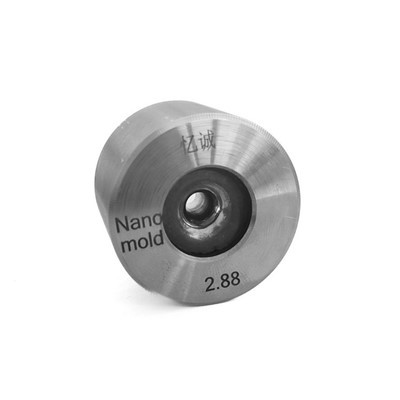
Nano Diamond Wire Drawing Dies
Diamond drawing die is a machine tooling used for drawing copper wire, aluminum wire, steel wire, stainless steel wire, copper-plated steel wire, tungsten wire, precious metal wire.Also, diamond dies are used in high-speed drawing of ultra-thin magnetic wire, ultra-thin tungsten wire, etc.Diamond dies are made from high-quality natural or synthetic diamonds, reliably pressed with insert reinforcement, cutting and polishing. They provide excellent quality and a smooth wire surface.The main advantages of using diamond dies are the excellent surface quality of the finished product, the low coefficient of friction during drawing, and the high wear resistance and durability of the die gauging zone.
Advantages of Nano Diamond Wire Drawing Dies
Unmatched hardness and durability
At the core of the advantages offered by diamond wire drawing dies is the extraordinary hardness of diamonds. Diamond is one of the hardest materials known to man, making it exceptionally resistant to wear. This inherent hardness ensures that diamond dies have an extended lifespan, outlasting other materials and maintaining their precision over prolonged use.
Precision beyond compare
Diamond wire drawing dies are synonymous with precision. Their exceptional hardness allows for the creation of fine wires with consistent diameters, meeting stringent tolerance requirements. This precision is paramount in industries such as electronics, telecommunications, and medical device manufacturing, where the quality of wires directly influences the performance of the final products.
Superior surface finish
The surface finish of drawn wires is a critical factor in various applications. Diamond wire drawing dies excel in providing superior surface finishes, ensuring that the drawn wires exhibit minimal imperfections. This characteristic is particularly advantageous in industries where smooth and flawless surfaces are essential, such as in the production of high-end cables, electronic components, and medical devices.
Versatility across industries
Diamond wire drawing dies find applications across a spectrum of industries, demonstrating their versatility. From the production of fine wires for electronics to robust cables for construction, diamond dies adapt to diverse manufacturing needs. Their ability to draw wires from various materials, including metals and alloys, positions them as indispensable tools in industries requiring precision and durability.


Why Choose Us
Our factory
Founded in 1980,cangzhou yicheng wire die co., ltd. Is a comprehensive die professional enterprise integrating r&d, production, sales and maintenance.Through the unremitting efforts of yicheng people, the production scale and service scope of the enterprise are expanding day by day.
Our product
At present, the main products are: Electromagnetic wire drawing die, power transformer wire drawing die, light voltage wire drawing die, wire and cable wire drawing die, diamond coated wire drawing die, stainless steel wire drawing die, etc.
Production market
The company's products are sold to more than 100 domestic enterprises in more than 20 provinces, accounting for 70% of the domestic market share.
R&d team
Cangzhou yicheng wire die co., ltd. Is a comprehensive die professional enterprise integrating r&d, production, sales and maintenance.
Steel mold
The materials used to make steel molds are mainly carbon tool steel and alloy tool steel. Due to the poor hardness and abrasion resistance and short life of steel molds, they have long been replaced by other molds.
Natural diamond (nc) mold
Natural diamonds are the earliest use of wire drawing mold materials in the world. The quality of the pull -up line has gradually become popular in the 1960s. Because natural diamond is expensive, it is only used to make small diameter molds.
Hard alloy model
Hard alloys entered the market in the early 20th century. By the 1950s, they replaced the softer steel molds. Its production technology continued to be updated and quality continued to improve, becoming the main material in the wire industry. Hard alloys are produced by powder metallurgical, which are synthesized by carbides (tungsten, titanium) and melting agent. The less the amount of drilling in the drawing mold, the harder the mold texture, but too little molds will become crispy. In addition, the thinner tungsten carbide particles, the higher the hardness.
Artificial polycrystalline diamond (pcd) mode
Artificial polycrystalline diamond is made of artificial diamond particles and metal melting cobalt molten under high temperature and high pressure. The mass alloy mold is 50 ~ 500 times long, and has good wear resistance and the maintenance of the mold hole circles, strong anti -tensile capacity, low mold cost, and the quality of the wires made by the pull -made wires. Quality alloys, especially in the process of continuous high -speed brushes, show their superiority. However, the domestic polycrystalline diamond has a large porosity, and the surface roughness value of the inner pores of the diamond wire drawing die finished product is high.
Ceramics
In recent years, ceramic brushes have been launched in japan, and its cost is much lower than the artificial polycrystal mold. Although this drawing model is not important during the pull -up process, it plays an important role in the tightness, twisted and guided processes of twisted machines and machines.
Surface enhancement
Because natural diamonds and excellent artificial polycrystalline diamond prices are much higher than hard alloy, people have used various means to change the alloy composition on the surface of the hard alloy wire drawing mold holes and the structure of the hard alloy drawing model, which improves its life span , to the need for high -speed drawing.
What is a diamond wire drawing die
The diamond wire drawing die refers to a tool that forces the diamond through the die under the action of external force during the diamond press processing, and the diamond cross-sectional area is compressed, and the required cross-sectional area shape and size are obtained.
Methods to improve the service life of diamond wire drawing dies
Maintain a suitable drawing surface shrinkage rate
The diamond wire drawing die itself has the characteristics of being hard and brittle. If it is used for the reduced diameter drawing with a large area shrinkage rate, it will easily lead to the stress that the die can withstand and be broken and scrapped. Therefore, according to the different mechanical properties of the wire, select the appropriate area shrinkage for drawing.The stainless steel wire is drawn with a diamond die, and generally the single-pass surface shrinkage rate does not exceed 20%.


Use lubricants with good lubricating properties
In the stretching process, the quality of lubricant and the supply of lubricant affect the service life of the drawing die. Therefore, the lubricant is required to have a stable oil base, good oxidation resistance, excellent lubricity, cooling and cleaning properties, and always maintain the best lubrication state throughout the production process, so as to form a film that can withstand high pressure without being damaged, reduce the friction in the working area and increase the service life of the mold. During use, the condition of the lubricating oil should be continuously observed. If severe discoloration or increase of metal powder in the lubricating oil is found, it should be replaced or filtered in time to avoid the lubricating performance of the lubricating oil from being degraded due to oxidation. At the same time, the fine metal particles falling off during the drawing process are prevented from damaging the diamond wire drawing die.
Regular maintenance and grinding of diamond wire drawing dies
In the process of long-term use of the wire drawing die, the die wall is strongly rubbed and scoured by the metal wire, which will inevitably produce abrasion. The most common one is the annular groove (dent) at the wire entrance in the working area. The appearance of the ring groove of the drawing die has aggravated the wear of the die hole, because the small particles of the core material peeled off due to the loosening of the ring groove are brought into the working area and the sizing area of the die hole by the metal wire, acting as an abrasive, and entering the wire of the die hole increases the wear of the die hole like a grinding pin. If it is not replaced in time for repair, the ring groove will continue to accelerate and expand, making repair more difficult, and there may even be cracks in the deeper part of the ring groove, causing the diamond wire drawing die to be completely broken and scrapped.
Diamond Wire Drawing Dies in Medical Device Production
Precision is paramount in the manufacturing of medical devices, where even the smallest components play a critical role in patient care. Among the tools contributing to this precision, diamond wire drawing dies stand out for their ability to produce fine wires used in intricate medical devices.
The crucial role of diamond wire drawing dies
In the realm of medical device production, where tolerances are often measured in microns, achieving precise dimensions is a non-negotiable requirement. Diamond wire drawing dies serve as key players in this process, allowing manufacturers to produce ultra-fine wires with consistent diameters, a prerequisite for the intricate components found in medical devices.
Diamond wire dies in device manufacturing
Medical devices encompass a vast array of products, from diagnostic tools to implantable devices, each requiring specific materials and dimensions. Diamond wire drawing dies are instrumental in the production of wires used in these devices, offering unparalleled precision and surface finish. Whether crafting fine wires for sensors or structural components for implants, the versatility of diamond dies contributes to the intricate nature of medical device manufacturing.
Ensuring quality in medical components
The use of diamond wire drawing dies in medical device production provides several advantages critical to the industry. The exceptional hardness of diamonds ensures prolonged die life, contributing to consistent wire quality over extended manufacturing runs. Moreover, the ability to produce wires with minimal surface imperfections is crucial for medical devices, where smooth surfaces are paramount to avoid complications in sensitive applications.
Diamond dies in medical device compliance
Medical devices are subject to stringent quality and safety standards, and the use of diamond wire drawing dies aligns with these requirements. Manufacturers can rely on diamond dies to meet the precision specifications demanded by regulatory bodies, ensuring that the wires used in medical devices adhere to the highest industry standards.
Advancing medical device technologies with diamonds
As medical device technologies advance, the role of diamond wire drawing dies continues to evolve. Ongoing research and development focus on enhancing the capabilities of these dies to accommodate the evolving needs of cutting-edge medical applications, including miniaturized devices, wearable technologies, and advanced diagnostic tools.
The integration of diamond wire drawing dies in medical device production exemplifies the commitment to intricate precision in the healthcare industry. These dies play a crucial role in crafting the wires that form the backbone of medical devices, contributing to the sector's ability to provide high-quality, reliable, and safe solutions for patient care.
Reasons and Analysis of Wear of Diamond Wire Drawing Die
The processing quality of the diamond wire drawing die itself leads to die wear
(1) The asymmetrical inlay of the diamond die blank and the die steel sleeve, and the uneven distribution or gaps of the sintered cemented carbide steel sleeve can easily lead to u-shaped cracks during wire drawing;
(2) During the laser drilling process of the diamond die blank, the sintering traces are not cleaned or unevenly heated, which will cause the metal catalysts and bonding agents in the diamond layer to gather together, which will easily lead to pits in the diamond wire drawing die during the wire drawing process;
(3) The mold hole design is unreasonable, the inlet lubrication area opening is too small, and the setting area is too long, which will cause poor lubrication, resulting in mold wear and even chipping.
Improper use in the drawing process leads to the wear of diamond wire drawing dies
(1) The drawing surface shrinkage is too large, causing cracks or breakage of the diamond wire drawing die. Most of the cracks or broken cracks are caused by the release of internal stress. In any material structure, the existence of internal stress is inevitable. The internal stress generated during wire drawing can enhance the diamond microcrystalline structure, but when the drawing surface shrinkage is too large, it cannot be lubricated in time, and the temperature rise will cause part of the material on the surface of the diamond wire drawing dies to be removed, and the stress on the microcrystalline structure will greatly increase, making it easier to crack or break.
(2) The drawing axis of the wire rod is asymmetrical with the center line of the die hole, resulting in uneven stress on the wire rod and the wire drawing die, and the impact generated by mechanical vibration will also cause high stress peaks on the wire rod and the drawing wire die, both of which will accelerate the wear of dies.
(3) Factors such as uneven wire hardness caused by uneven annealing can easily cause premature fatigue damage to the diamond wire drawing die, forming annular grooves, and aggravating die hole wear.
(4) The wire surface is rough, and the surface adhesion of oxide layer, sand or other impurities will cause the dies to wear out too quickly. When the wire passes through the die hole, the hard and brittle oxide layer and other adhering impurities will cause the wire drawing die hole to wear quickly and scratch the wire surface like abrasives.
(5) Poor lubrication or the lubricating oil contains metal debris and impurities that cause mold wear. Poor lubrication will cause the surface temperature of the diamond die hole to rise too fast during wire drawing, and the diamond grains will fall off, resulting in damage to the die. When the lubricating oil is not clean, especially when it contains metal chips that fall off during drawing, it is very easy to scratch the surface of the mold and the wire.
Jewelry Crafting With Diamond Wire Drawing Dies
Efficiency in wire drawing
The primary role of diamond wire drawing dies is to reduce the diameter of wires, which is crucial for creating intricate jewelry designs. The dies are designed with precision, allowing jewelers to achieve the desired wire thickness consistently. Through a controlled process, the wires are pulled through the die, gradually reducing their diameter. This process can be repeated multiple times until the desired thickness is achieved. Diamond wire drawing dies ensure excellent precision and efficiency, resulting in consistent and reliable outcomes.
Superior versatility
Diamond wire drawing dies are capable of working with a wide range of materials, from common metals like gold, silver, and platinum to more exotic materials like titanium and tungsten. The versatility of these dies allows jewelers to explore a variety of design possibilities, creating unique and original jewelry pieces. Whether it is a delicate necklace, a stunning bracelet, or a pair of exquisite earrings, diamond wire drawing dies offer endless possibilities in jewelry crafting.
Enhanced quality and durability
The inherent hardness of diamonds makes them an ideal material for wire drawing dies. Diamond dies ensure excellent wear resistance, reducing the need for frequent replacements. This ensures that the wire drawing process remains consistent, resulting in high-quality jewelry pieces. Diamonds also offer superior thermal conductivity, enabling the dies to dissipate heat effectively and preventing the wires from becoming overheated during the drawing process. The result is a flawless finish and longer-lasting jewelry pieces.
Advancements in technology
Over the years, advancements in technology have further improved the efficiency and precision of diamond wire drawing dies. Computer-aided design (cad) and computer-aided manufacturing (cam) technologies have revolutionized the jewelry industry. Jewelers can now create intricate designs digitally and translate them into physical jewelry pieces using diamond wire drawing dies. This integration of technology and craftsmanship has opened up new horizons in jewelry making, allowing for more complex and unique designs to be realized.
FAQ
We're well-known as one of the leading nano diamond wire drawing dies manufacturers and suppliers in China. Please rest assured to wholesale high quality nano diamond wire drawing dies at competitive price from our factory. For customized service, contact us now.
Steel Wire Drawing Die, Copper Wire Drawing Die, Welding Wire Drawing Die